Posts

Keep the Option of Paying Fares with Cash
Image
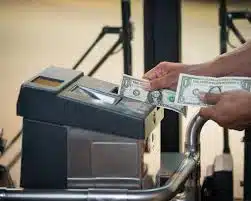
As we emerge from the COVID-19 pandemic, we must prioritize confronting ongoing challenges, including housing affordability, transit access , and resiliency in the face of a changing climate. -- From April 13, 2021 memo to city Department on Division Heads on Proposals for the 2022 Capital Budget (https://www.cityofmadison.com/finance/documents/budget/2022/capital/CapitalMayorMessage.pdf; bold added)   How accessible would you consider the transit system if a new or occasional would-be bus rider were denied a bus ride because she/he/they tried to pay the fare in cash? Madison's Metro Transit just temporarily suspended its recommendation that its fare collection go cashless. For how long is anyone's guess. It had been proposing for months that fares for a new Bus Rapid Transit line be cashless from the outset and that the regular buses go cashless within five years. That is wrong. Metro must keep a cash option . The Money Conundrum Metro's tone-deaf proposa...
For a Future that is Cleaner, Healthier and More Equitable

Image
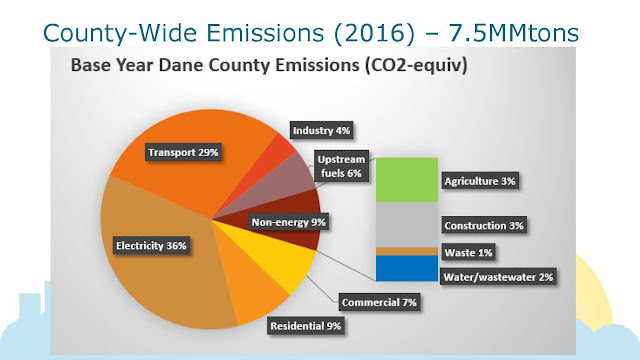
Source: 2020 Dane County Climate Action Plan p.66   According to Dane County's 2020 Climate Action Plan , 29 percent of the county's CO2 emissions in 2016 could be attributed to transportation (p.66). ( National figures are similar.) The Plan also lists "equity and justice" as the first of six guiding principles (p.36). One might expect therefore, that a big part of the county's effort to reduce greenhouse gas emissions would be to pursue "transportation equity" or to ensure "accessible and affordable transportation for everyone." And as someone who prioritizes access to opportunity and oversaw the creation of the county office of energy and climate change, the reader might expect that the county executive would spearhead the effort toward achieving transportation equity. It is both surprising and disappointing therefore that nothing could be farther from the truth. One might expect the transportation part of the Climate Action Plan to have ...

Voting Access for Public Transit Riders

Image
Courtesy: Michael Mirer In April of 2021, perhaps for the last time, the City of Madison will elect 20 City Council members for a 2-year period. Among their duties, Council members pass annual budgets that set taxes and determine how those taxes get spent. Those budgetary decisions in turn impact everything, from housing and police, to parks and yes, transportation. Various politically-minded groups gear up for this event, help with political campaigns and/or endorse particular candidates. Their activity is based on the probably incorrect premise that potential or actual transit riders are as able to vote as others. It should be correct, and the Dane County Voter ID Coalition has assigned itself the task of identifying voters who may not have an acceptable voter photo ID, then arranging for them to receive assistance in obtaining one. Madison city elections always take place in the Spring, and voter turnout in Spring elections tends to be lower than in the Fall. In ...

Improve Public Transit Without Displacement-1

Image
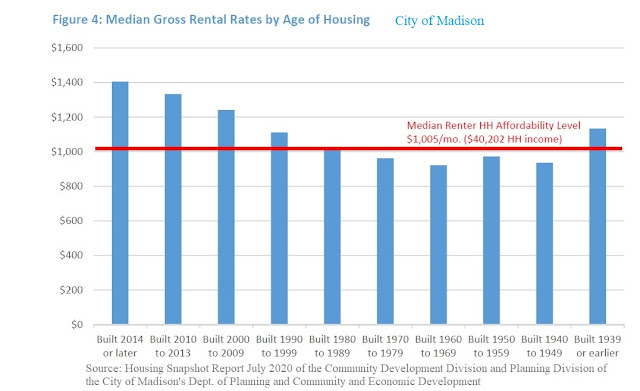
  Madison Needs to Improve Public Transit Without Displacement Part I John Swingle and Susan De Vos Transit advocates in Madison and elsewhere are quick to point out that traveling with one less car can save a household on average over $9,000 a year (based on national 2019 figures for traveling 15,000 miles), whether that household goes from having two to one car, one to no car or just not getting a car in the first place. Transit advocates also tout the socially inclusive nature of a public system that serves people of all ages, incomes, ethnicities, and physical abilities. And they argue that even riding diesel, rather than electric, buses can substantially cut down on one's carbon footprint while enabling road diets and the reclamation of public space disproportionately allocated to car parking. After all, the city's 2018 Comprehensive Plan 's #1 transportation strategy (p. 30) is "Improve transit service, especially to peripheral employment and residen...

A Pique About Peak

Image
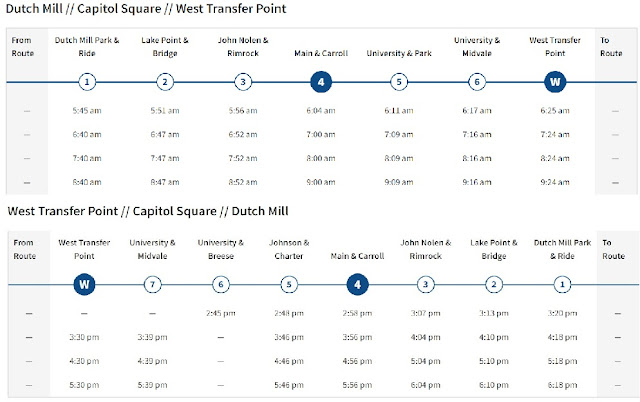
 Weekday Peak Schedule for Route 12 as of 12/7/2020 Although still only a fifth of what it was compared to a year earlier, Metro ridership in September and October 2020 has climbed back from its 10% level of March and April 2020. And thanks in large part to a grant of about $24.5 Million from the federal government's CARES Act , Metro began operating back at 85 percent of its previous year's level beginning at the end of August. Earlier, it had been running a much leaner Saturday-type service as people were minimizing potentially risky exposure to a new and often- lethal virus. Much of Metro's core routing was re-instated in late August 2020 but much of the more limited peak service to peripheral areas was not. Half the peak runs remained eliminated although they were often the only transit service available in the areas they served. Ironically, it is peripheral areas that house some of Madison's most low-income residents who can benefit most financially from not h...

When Improvement Means Back to 85% of Normal

Image
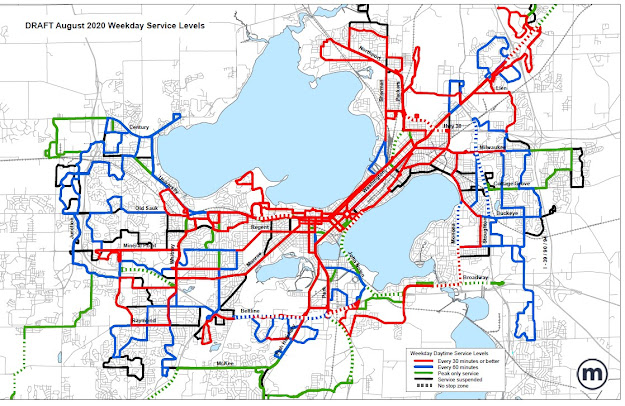
Weekday Service Beginning August 23, 2020 When Improvement Means Back to 85% of Normal Susan De Vos and Yvonne Schwinge Beginning August 23, 2020 Madison Metro Transit resumed a roughly 85% level of regular service (revenue hours), a huge improvement over to its much leaner "essential" routing that began near the end of March. At that time, Madisonians got to see how essential it is to have a public transit system that continues to operate, even during a pandemic, and even in a much-reduced form. While ridership may have fallen to less than a tenth of what it had been in the span of only a few days, that one-tenth were essential travelers who enabled the rest of us to stay Safer at Home . Buses were run on a modified Saturday schedule with a maximum of 15 passengers. They were disinfected thoroughly at least once a day and everyone was strongly encouraged to wear masks. Passengers who could, were required to enter through the back door. No fare was collected....

Madison Timidly Reserves Two Short Lane Spans for Buses Only

Image
from " Reduced VMT and Opportunities " (item 11) Presented May 4, 2020 by MDOT to the Transportation Policy and Planning Board One effect of the general shutdown of most activity outside the home from early March until the end of May in Madison was a massive decline in the use of public streets by automobiles and a re-evaluation of how much of our public space should be assigned to cars. According to data gleaned from the city's 2018 Comprehensive Plan (Table 1 of Appendix B [p. 127 of part 3]), roughly a fifth of the city's land is devoted to public roads, more than is devoted to "parks & open spaces," or "commercial office space" and only less than the amount devoted to residences themselves.  Although the first shut down was eased at the end of May and car travel had rebounded accordingly, at the time of this writing strict sanctions are being reimposed. Dane County is suffering from a dramatic resurgence in new COVID-19 cases, the spike a...